Forex Scams in Kenya and How to Check a Broker's Licence
Forex trading is legal in Kenya, but only brokers on the CMA licensees register are regulated locally.
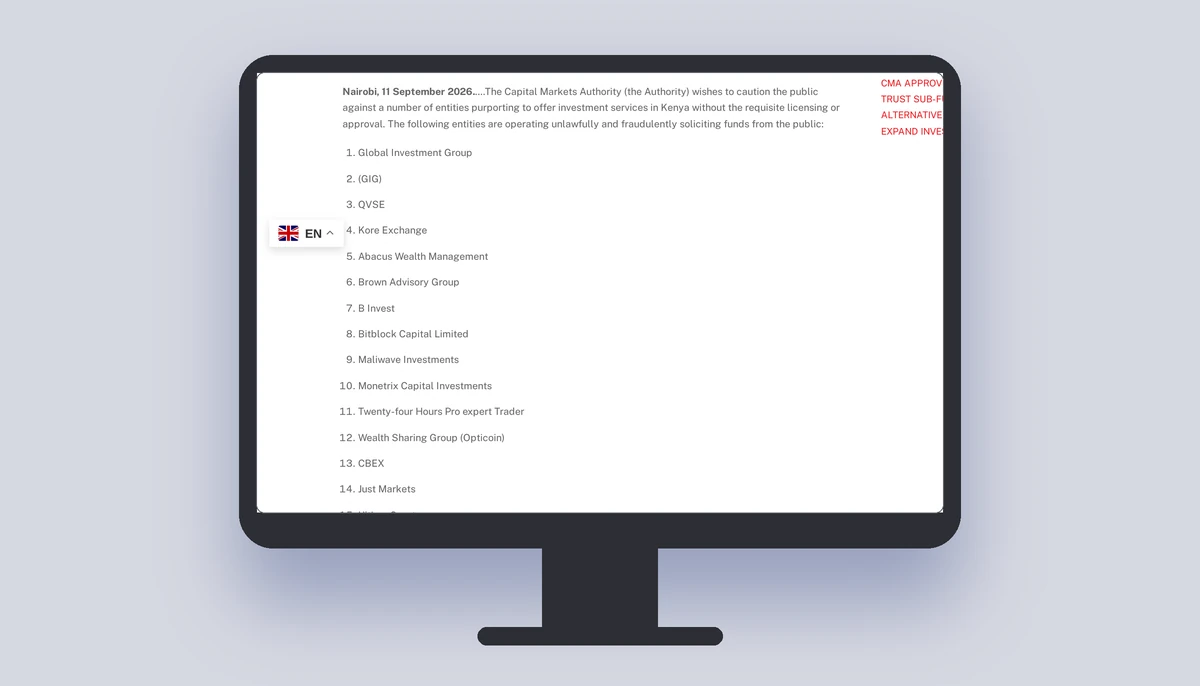
Trading forex is legal in Kenya, but the platform you use may not be regulated here
Forex trading itself is legal in Kenya. What is not legal is a firm holding itself out as a broker, taking your deposits, and offering trading services without a licence from the Capital Markets Authority of Kenya, known as the CMA.
That distinction matters because most apps you see advertised on Kenyan social media are not licensed locally. Some are licensed in another country and simply accept Kenyan clients. Others have no licence anywhere. The only way to tell the difference is to check the CMA licensees register at cma.or.ke yourself, before you fund anything.
You do not need to be an expert to do this. You need the exact company name, not the app name, and five minutes on the CMA website.
| Field | What it says |
|---|---|
| Regulator | Capital Markets Authority of Kenya (CMA) |
| Register | CMA licensees register |
| Published at | cma.or.ke |
| Covers retail forex | Yes — the register has a category for it |
| Last read by us | 2026-09-29 |
| Entries transcribed here | 16 |
A register says whether a firm holds a licence on the day you look, and nothing about how it treats clients. Search the legal entity from the broker's own footer, not the brand.
The scam patterns that keep catching Kenyan traders
The most common pattern is the WhatsApp or Telegram group. Someone you have never met posts screenshots of winning trades, then invites you to a "mentorship" or a "signal room". The deposit is small at first. Once you send more, the withdrawals stop working and the group goes quiet.
The second pattern is the fake trading app. It looks polished, shows a rising balance, and lets you deposit through M-Pesa or Airtel Money in seconds. The balance is not real. It is a number on a screen controlled by whoever built the app. Withdrawals are blocked, delayed, or met with a request for a "release fee" you must pay first.
The third pattern is the unlicensed offshore broker with a Kenyan-facing website. It may be a real brokerage, but it is not answerable to the CMA. If it refuses your withdrawal, your options are limited to whatever regulator, if any, sits in its home country. That is a long way from Nairobi.
A fourth pattern is the recovery scam. Someone contacts you after you have already lost money, claiming they can get it back for an upfront fee. They cannot. Nobody can.
| What you see | What to check |
|---|---|
| A fixed monthly return, promised in advance | Ask which licence permits it, then look the firm up on the CMA licensees register. |
| A deposit asked for in gift cards or vouchers | Check the broker's own funding page: firms list bank, card and wallet rails, not vouchers. |
| Someone offering to trade the account for you | Managing money for a client is a separate permission. The register says whether a firm holds it. |
| A withdrawal released only after a new payment | Read the withdrawal terms you agreed to. A fee invented at payout time is not in them. |
None of this is a judgement about any firm. Each line is a check you can run yourself, starting at cma.or.ke.
Checking a licence takes five minutes and costs nothing
Go to cma.or.ke and open the licensees register. Search the exact legal name of the company, not the brand name on the app. If it is not there, the firm is not licensed by the CMA to offer those services in Kenya.
If the company claims a foreign licence, check that regulator's own register too. A licence number printed on a website proves nothing on its own. Anyone can type a number into a footer.
Before you deposit, read the funding page carefully. Check which payment methods are offered, what currency the account is denominated in, and what the withdrawal process actually says. If the only way to deposit is M-Pesa to a personal number rather than a company paybill or till, stop. That is not how a regulated firm collects client money.
Keep your own records. Save the deposit confirmation from the M-Pesa app, the account statement, and any chat messages. If something goes wrong, those are the documents that matter.
| Figure | Source | Checked |
|---|---|---|
| Licensee names and status | CMA licensees register — cma.or.ke | 2026-09-29 |
| Session windows | Fixed UTC windows; London and New York shift in their DST | On change |
| USD/KES | open.er-api.com | 2026-09-28 |
| Funding limits and fees | Set by the provider and the broker — not published here | Changes without notice |
A figure with no source and no date is a guess with good manners. Anything we could not trace is left out rather than printed from memory.
Protecting the money you have already funded
Risk management is the part most Kenyan traders skip, and it is the part that decides whether you are still trading next year. The single most useful habit is deciding your loss before you enter a trade, not after. That means a stop loss on every position, set when you open it.
A risk calculator helps you size a position so that one bad trade does not wipe the account. You can find these free online, or build a simple one in a spreadsheet. The inputs are your account balance, the percentage you are willing to lose on the trade, and the distance to your stop loss. The output is your lot size.
Trade the sessions you can actually watch. London runs 10:00 to 19:00 EAT and New York runs 15:00 to 00:00 EAT, so the busiest window for most pairs is the 15:00 to 19:00 EAT overlap. Trading thin hours on a phone, half awake, is how accounts get emptied.
Finally, treat any promise of guaranteed returns as a reason to walk away. No licensed broker and no honest educator will make one.
A trading day on an EAT clock
- Busiest window
- 15:00-19:00 EAT — London and New York open together
- Thinnest stretch
- 00:00-09:00 EAT — Sydney alone, wider spreads
- European open
- 10:00-19:00 EAT
- US open
- 15:00-00:00 EAT
- Closed
- Friday New York close until the Sydney open on Monday
Hours are shown for the clocks in force today: London is on BST until 25 October, New York is on EDT until 1 November. Kenya does not change clocks, so each move shifts these local times by an hour and the page is rebuilt on the day it happens.
A licence from another country does not cover a Kenyan account
Many offshore brokers hold a licence from a different regulator and display that badge prominently. That badge tells you nothing about whether the firm may legally serve Kenyan residents. The CMA register at cma.or.ke is the list that matters for a complaint arising in Kenya.
This distinction matters most when something goes wrong. A foreign regulator will usually ask you to complain in the country where the firm is licensed, in its language, under its process. Your money left through M-Pesa in Nairobi, but your dispute may belong to an office thousands of kilometres away.
Check the register before funding, not after. If the firm does not appear, treat the overseas licence as a marketing detail rather than a protection. Nothing about a glossy badge changes where you would actually have to pursue a claim.
| Figure | Value | Source |
|---|---|---|
| Indicative USD/KES | 129.62 | open.er-api.com, pulled 2026-09-28 |
| How often it moves | Every trading day | — |
| The rate your account uses | Your broker's own conversion | The broker's rate card |
| Symbol on this site | KSh | — |
An indicative rate is for sizing a position in your head, not for settling one. The gap between it and your broker's conversion is part of what a trade costs you.
The funding step is where most Kenyan losses become permanent
Scam platforms rarely ask for a bank transfer first. They send an M-Pesa till or paybill number, often in a person's name rather than a company name, and the payment clears in seconds. Once that confirmation message arrives, the money is gone from your control.
A regulated firm routes deposits to an account in its own registered name. If the payment details name an individual, or change between your first and second deposit, stop and verify before sending anything. Payment detail changes are a common warning sign, not a routine update.
Keep the M-Pesa confirmation messages. They carry the transaction code, the recipient and the time, which is exactly what a bank, the CMA or the police will ask for. Screenshots of a trading dashboard prove far less than a payment record from your own phone.
| Rail | What it is | Who sets the limit and the fee |
|---|---|---|
| M-Pesa · used most | Mobile wallet | The wallet provider and the broker |
| Airtel Money | Mobile wallet | The wallet provider and the broker |
| Bank transfer | Bank transfer | Your bank and the broker |
| Card | Card payment | Your card issuer and the broker |
Limits and fees are set by the provider and the broker and change without notice, so they are not printed here. Confirm both in the provider's app and on the broker's funding page, and withdraw to the same account you paid from.
Withdrawals are the real test, so run a small one early
A platform can look flawless while you are depositing and behave differently the moment you request money back. The usual pattern is a withdrawal that needs a new fee, a tax payment or a minimum balance cleared first. Those requests are the scam, not a step in the process.
Test this early with a modest withdrawal shortly after funding, before you commit more. A firm that processes it normally is behaving like a business. A firm that invents a condition you never agreed to has shown you what the rest of the relationship looks like.
Read the broker's own funding and withdrawal page for the stated process and timelines rather than trusting a support agent's message. If the written terms and the agent's instructions disagree, the written terms are what you can hold anyone to later.
| Document | What it proves |
|---|---|
| National ID or passport | Who you are |
| Selfie with the ID document | That the document is in your hands |
Brokers usually also ask for proof of address - utility bill or bank statement; requirements differ per firm. The account-opening page of the broker lists what that firm accepts.
Reporting after a loss still changes your options
Traders often assume that once money leaves via M-Pesa, nothing can be done. That is not quite right. Speed matters, and a report made within days gives the recipient's details a chance of being traced while the accounts are still active and the trail is fresh.
Report to the CMA if the firm claims to be licensed or appears on the register. Report to the police for the payment itself. Tell your mobile money provider and your bank as well, since each keeps its own record of where the funds went and can flag the recipient.
Write down what happened while it is fresh: dates, amounts, the names on the payment messages, and what the platform told you. A clear written account is what every office you approach will ask for first, and reconstructing it months later is much harder.
| Platform | What it is | Who makes it |
|---|---|---|
| MetaTrader 4 | The older standard; expert advisors and a large script ecosystem | MetaQuotes |
| MetaTrader 5 | The newer build; more order types and timeframes | MetaQuotes |
| cTrader | Depth of market and a different order model | Spotware |
| The broker's own app | Usually simpler, and tied to that one firm | The broker |
A platform is software, not a safeguard: the same terminal is offered by licensed and unlicensed firms alike. The licence question is answered on the register, not in the app store.
Questions
Forex trading is legal in Kenya. What varies is whether the firm you are trading with is licensed by the Capital Markets Authority. Check the CMA licensees register at cma.or.ke using the company's exact legal name before you send any money. If it is not on the register, it is not regulated here.
Find the company behind the app, then search that company name on the CMA register at cma.or.ke. A polished app, a large social media following, or a licence number in the footer proves nothing. Also check how deposits are collected. A regulated firm uses a company paybill or till, not a personal M-Pesa number.
Confirm the broker is on the CMA register, confirm the payment goes to a company paybill or till rather than an individual, and read the funding page for the withdrawal process. Save the M-Pesa confirmation message and your account statement. If a firm asks for an upfront fee to release a withdrawal, that is a scam.